
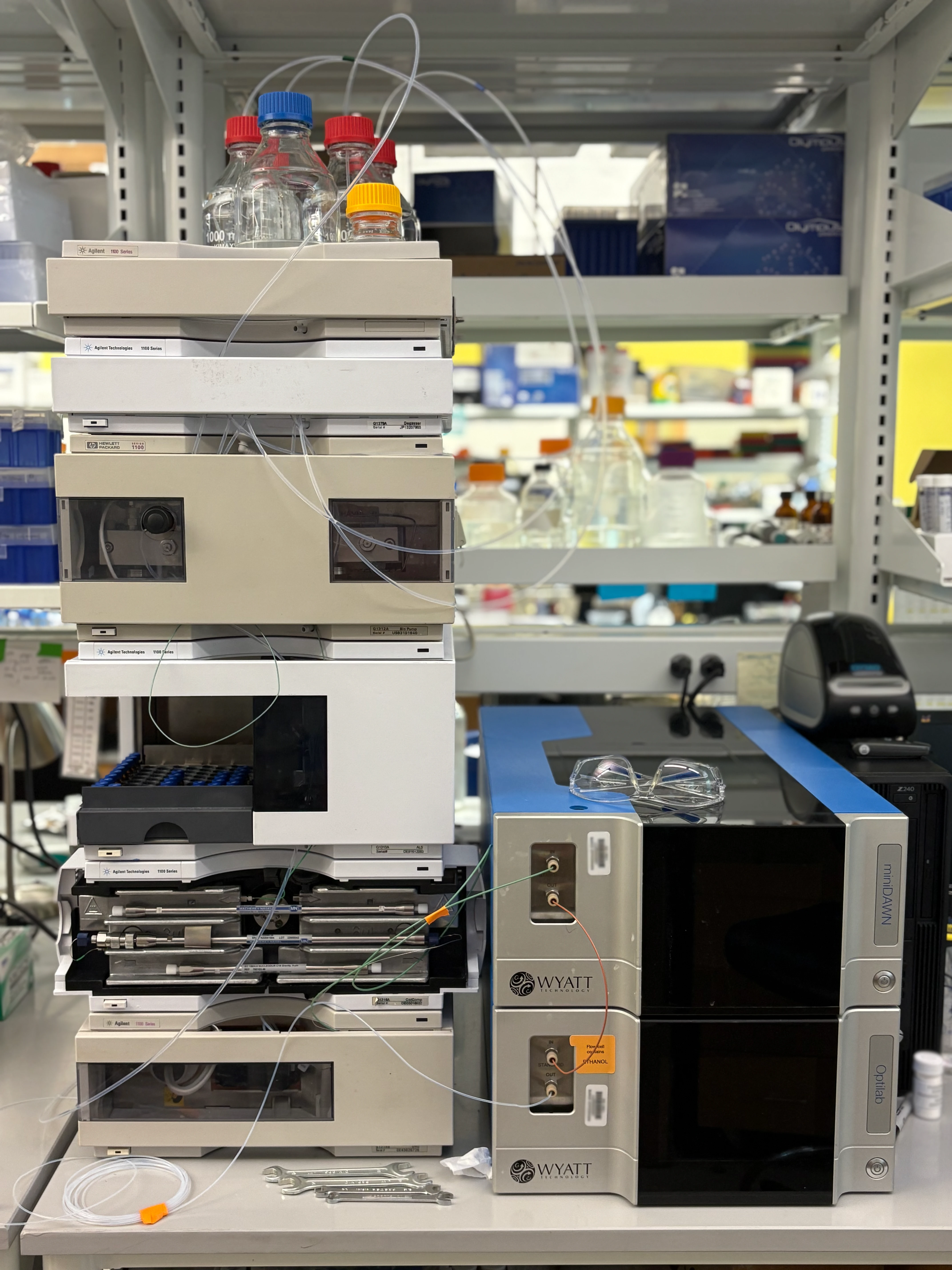
High-performance liquid chromatography (HPLC) is one of the most widely used analytical techniques for separating, identifying, and quantifying compounds in liquid samples. It is especially useful for analytes that are non-volatile, thermally sensitive, or present in complex sample matrices. For customers, that makes HPLC a highly practical platform for both routine quality control and product development work.
Across regulated and commercial industries, HPLC supports decisions that go beyond a simple assay result. It can be used to confirm active concentration, monitor impurities, assess formulation behavior, evaluate degradation, and generate reliable data for specification setting. When properly developed and validated, an HPLC method becomes a dependable tool for release testing, troubleshooting, and ongoing product support.
Why HPLC remains essential
One of the main strengths of HPLC is its versatility. A single platform can be adapted to a wide variety of chemistries by selecting the right column, mobile phase, gradient profile, and detector. That flexibility allows the same technique to be used across product classes that differ widely in composition and analytical challenges.
HPLC also offers the precision and reproducibility needed for customer-facing data packages. In a QC environment, this means consistent measurement of assay, related compounds, and product uniformity. In a development setting, it allows scientists to compare prototypes, evaluate process changes, and understand how a product behaves over time or under stress.
What demonstrates proficiency in HPLC
Strong HPLC work starts with understanding the chemistry of the sample. That includes analyte polarity, solubility, UV response, stability, expected concentration range, and likely matrix interferences. Method development is not just about generating peaks; it is about ensuring the target compound is well resolved from impurities, degradants, excipients, and other sample components.
Analytical proficiency is reflected in choices such as:
- Appropriate stationary phase selection, such as C18, C8, phenyl, cyano, or amino columns.
- Mobile phase design that balances retention, selectivity, and peak shape.
- Isocratic or gradient elution depending on the complexity of the sample.
- Detection strategy, often UV, PDA, fluorescence, or other suitable modes.
- Sample preparation that minimizes matrix effects while preserving analyte recovery.
- System suitability criteria that confirm the method is performing as intended.
Method validation is equally important. A customer-ready HPLC method should demonstrate specificity, linearity, accuracy, precision, robustness, and suitable detection and quantitation limits for the intended application. It should also be reliable across normal variations in analyst, instrument, day, and sample handling conditions.
HPLC in agrochemicals and pesticides
In agrochemicals and pesticides, HPLC is commonly used for active ingredient determination, formulation analysis, impurity monitoring, and residue-related studies. Many pesticide compounds are well suited to liquid chromatographic analysis because they may be polar, thermally labile, or difficult to evaluate by gas chromatography without derivatization or specialized conditions.
For product development, HPLC can help compare formulation options, evaluate active stability, and monitor degradation in concentrates or finished products. For QC, it is frequently used to verify label claim, confirm manufacturing consistency, and support release testing. In residue and related studies, the same technique can be adapted to challenging matrices such as water, soil, crops, and formulated products.
HPLC in pharmaceuticals
In pharmaceutical analysis, HPLC is a foundational technique for both development and manufacturing support. It is routinely used to quantify active pharmaceutical ingredients, related substances, excipients, and degradation products. This makes it central to assay methods, impurity methods, and stability-indicating procedures.
From a customer perspective, pharmaceutical HPLC data is most valuable when it answers practical questions clearly. Does the batch meet specification? Has the formulation altered the impurity profile? Is the API stable under the proposed storage condition? A well-designed HPLC method helps answer those questions with data that is both technically sound and easy to interpret.
HPLC in industrial chemicals
Industrial chemical products often involve complex mixtures, closely related compounds, or process-derived byproducts that require more than a simple bulk measurement. HPLC is useful in these applications because it can separate chemically similar components and provide quantitative information on individual peaks within a mixture.
This supports a range of needs, including raw material verification, process monitoring, contaminant tracking, and finished product consistency. For manufacturers, HPLC data can connect analytical chemistry to process performance by showing how formulation, production conditions, or storage influence the final product profile.
HPLC in dietary supplements
Dietary supplements present a different but equally important analytical challenge. Products may contain botanical extracts, vitamins, amino acids, specialty actives, and complex excipient systems, all of which can complicate quantitation. HPLC is often used to verify label claim, check lot-to-lot consistency, and distinguish the target analyte from background matrix components.
This is particularly important in product development, where teams may be comparing ingredient sources, refining formulations, or evaluating shelf-life performance. In QC, the focus is often on accurate potency testing and confidence that the result reflects the true product composition rather than interference from the matrix.
What useful customer data looks like
A strong HPLC report does more than provide a single result. It should present a clear analytical story that links chromatographic performance to a decision. In practice, that means combining representative chromatograms, calibration data, peak identification strategy, quantitative results, and method performance in a format that customers can use with confidence.
For quality control customers, the most important outcomes are usually assay, purity, consistency, and repeatability. For product development customers, the focus may shift toward comparative behavior, degradation trends, formulation impact, or impurity evolution. A laboratory that demonstrates real proficiency in HPLC can support both needs with methods that are technically rigorous and fit for purpose.
Why this matters to customers
Customers do not just need a chromatogram; they need actionable information. They want to know whether a batch passes, whether a formulation is stable, whether an impurity is increasing, or whether a new prototype performs better than the last one. HPLC is powerful because it can answer those questions with specificity and quantitative confidence.
That is why HPLC remains one of the most valuable analytical techniques across agrochemicals and pesticides, pharmaceuticals, industrial chemicals, and dietary supplements. When the method is thoughtfully developed, properly validated, and clearly reported, HPLC becomes more than an instrument technique. It becomes a decision-making tool for quality, compliance, and product advancement.