
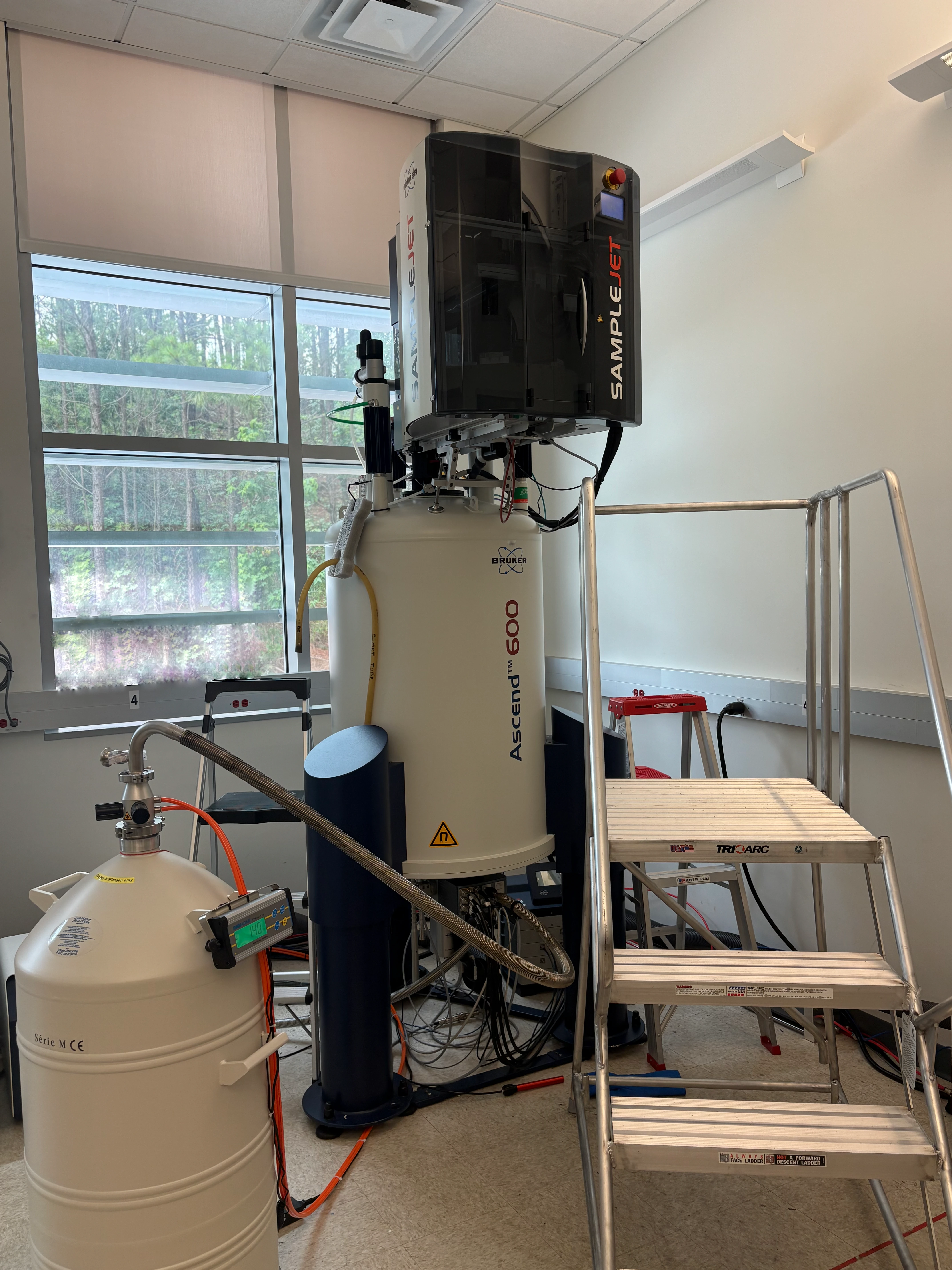
Nuclear Magnetic Resonance (NMR) spectroscopy is one of the most powerful analytical tools available for confirming chemical identity, assessing purity, and supporting product development. Unlike techniques that focus mainly on targeted components, NMR provides a broad structural view of a material. That makes it especially valuable when the question is not just “Is the target present?” but also “Is this the right molecule, in the right form, at the right quality?”
For manufacturers, formulators, and R&D teams, NMR can answer critical questions in quality control, failure investigations, formulation work, and batch comparison. It is widely applicable across agrochemicals and pesticides, pharmaceuticals, industrial chemicals, and dietary supplements.
Why NMR Matters
NMR measures the magnetic behavior of atomic nuclei in a molecule, most commonly $^{1}$H and $^{13}$C. The resulting spectrum contains information about molecular environment, connectivity, and relative composition. In practical terms, this means NMR can help determine:
- Whether a material matches its expected structure.
- Whether impurities, residual starting materials, or degradation products are present.
- Whether isomers, conformers, or substitution patterns are consistent with specification.
- Whether one batch is chemically comparable to another.
- Whether a formulation change altered the active ingredient or surrounding matrix.
- Whether a compound can be quantified by quantitative NMR, often called qNMR.
Because the technique is inherently structural, it is often used to complement chromatographic methods such as HPLC or GC. Chromatography may show that peaks are present at expected retention times; NMR helps show whether the chemistry behind those peaks is actually correct.
What NMR Is Best Used For
NMR is particularly strong when customers need high-confidence identity data or deeper characterization than a routine assay can provide.
Common QC Uses
- Raw material identity confirmation.
- Finished product verification.
- Lot-to-lot comparison.
- Detection of unexpected impurities or degradants.
- Verification of isomer ratio or substitution pattern.
- Confirmation of synthetic intermediate identity.
- Support for out-of-specification or complaint investigations.
Common Product Development Uses
- Structural confirmation of newly synthesized compounds.
- Reaction monitoring and intermediate tracking.
- Characterization of side products.
- Comparison of alternative synthetic routes.
- Formulation compatibility studies.
- Verification of ingredient integrity after processing, storage, or stress testing.
Techniques Commonly Used
A strong NMR workflow is not limited to a single spectrum. The experiment set depends on the question being asked.
1D NMR
- $^{1}$H NMR is typically the first-line experiment for identity, purity screening, and comparison work.
- $^{13}$C NMR provides complementary carbon framework information and is often critical for structural confirmation.
- DEPT experiments help distinguish methyl, methylene, methine, and quaternary carbons.
2D NMR
When the structure is more complex, 2D experiments are often necessary:
- COSY shows proton-proton coupling relationships.
- HSQC correlates protons with directly attached carbons.
- HMBC provides longer-range proton-carbon connectivity and is especially useful for establishing substitution patterns.
- NOESY or ROESY can support stereochemical or spatial assignments in some systems.
Quantitative NMR
qNMR is especially useful when a customer needs a defensible assay based on molar response rather than detector-specific calibration behavior. With an appropriate internal standard, controlled acquisition parameters, and suitable sample preparation, qNMR can support:
- Purity determination.
- Assay of active ingredient content.
- Reference material value assignment.
- Cross-checking of concentration against chromatographic methods.
Industry Applications
Agrochemicals and Pesticides
NMR is highly useful for technical-grade actives, intermediates, and formulated products where structural confirmation matters.
Typical applications include:
- Confirmation of active ingredient identity.
- Distinguishing regioisomers or positional isomers.
- Checking technical material purity.
- Investigating degradation after heat, light, or storage exposure.
- Verifying batch consistency during process changes.
- Supporting impurity profiling during development or supplier qualification.
For pesticide and agrochemical products, NMR often works best as part of a broader characterization package alongside HPLC, GC, LC-MS, or elemental analysis.
Pharmaceuticals
In pharmaceutical development and QC, NMR is routinely used for structural confirmation and impurity investigation.
Typical applications include:
- API identity confirmation.
- Characterization of synthetic intermediates.
- Structural support for forced degradation studies.
- Verification of salt form or polymorph-related composition changes when paired with other techniques.
- Purity assessment by qNMR.
- Comparability assessments during process development.
For early development, NMR is often indispensable. For later-stage quality systems, it can serve as a targeted orthogonal method when identity or structural questions remain unresolved by chromatographic testing alone.
Industrial Chemicals
Industrial products often involve mixtures, oligomeric systems, solvents, additives, or proprietary process chemistries where broad structural screening is valuable.
Typical applications include:
- Verification of incoming raw materials.
- Characterization of reaction products and byproducts.
- Investigation of off-odor, discoloration, or unexpected performance changes.
- Comparison of customer returns against retained samples.
- Confirmation of additive packages or blend composition trends.
- Support for reverse engineering or competitive benchmarking.
Dietary Supplements
Dietary supplements can present complicated matrices, botanical variability, and label-claim questions. NMR can help in situations where identity and matrix integrity are central concerns.
Typical applications include:
- Confirmation of known actives in purified ingredients.
- Comparison of lots for consistency.
- Screening for substitution or unexpected composition differences.
- Characterization of isolated fractions or concentrates.
- Support for formulation development and supplier verification.
In supplement work, the value of NMR depends strongly on the sample type. A purified isolate may be ideal for structural confirmation, while a complex botanical powder may require extraction, fractionation, or complementary methods to produce actionable data.
What Customers Receive
A useful NMR data package should do more than provide a spectrum. Customers generally need interpretation tied to a real decision.
A typical deliverable may include:
- Description of the sample as received.
- Experimental conditions, including solvent, frequency, and experiment type.
- Processed spectra.
- Peak assignments when appropriate.
- Interpretation of whether the data support the proposed identity.
- Comparison to reference material, literature, or expected structure when available.
- Discussion of notable impurities, unexpected resonances, or unresolved features.
- If requested, qNMR calculations with assumptions and reference standard details.
For QC customers, the most valuable output is often a clear statement such as: “The submitted sample is consistent with the expected structure,” or “The sample shows additional resonances inconsistent with the reference lot.” For R&D customers, the discussion may go deeper into assignment logic and structural alternatives.
Sample Requirements and Practical Considerations
The quality of NMR data depends heavily on sample suitability. In most cases, customers should expect to discuss:
- Approximate sample mass available.
- Expected identity or proposed structure.
- Purity level, if known.
- Solubility behavior.
- Matrix complexity.
- Whether quantitative results are needed.
- Whether comparison to a reference standard or prior batch is required.
Important practical factors include:
- Solubility in an appropriate deuterated solvent.
- Concentration sufficient for the requested experiment set.
- Sample stability during preparation and acquisition.
- Presence of water, salts, excipients, surfactants, or polymers that may complicate interpretation.
As a simple example, a clean technical active may only require $^{1}$H and $^{13}$C NMR for confident confirmation. A formulated suspension concentrate or dietary supplement extract may require more selective preparation and a more interpretive workflow.
Where NMR Fits with Other Techniques
NMR is extremely powerful, but it is not a universal replacement for chromatography or mass spectrometry. The best analytical strategy usually matches the technique to the decision.
NMR is strongest when you need:
- Structural confirmation.
- Broad visibility into the molecular framework.
- Non-selective purity assessment for many organic components.
- Isomer or substitution-pattern insight.
- Orthogonal confirmation to support HPLC, GC, or LC-MS findings.
Other techniques may be better when you need:
- Trace-level impurity detection far below NMR sensitivity.
- Separation and quantitation in very complex mixtures.
- Highly routine release testing of one known analyte at low concentration.
- Elemental, inorganic, or surface-specific information.
In practice, the most defensible investigations often combine methods. For example, HPLC may quantify a purity profile, LC-MS may help assign unknown masses, and NMR may confirm the actual structure of the main component or isolated impurity.
Why NMR Is Valuable for QC Decisions
For quality systems, confidence matters. NMR provides a direct molecular fingerprint that can reduce uncertainty when a batch behaves unexpectedly, when a supplier changes, or when chromatographic results alone are not conclusive.
That is why NMR is often chosen for:
- Supplier qualification.
- Reference standard confirmation.
- Investigations of unexpected assay shifts.
- Verification after process modifications.
- Batch release support for high-value materials.
- Technical support packages for customers, auditors, or regulators.
Why NMR Is Valuable for Product Development
During development, chemistry moves faster than formal methods. NMR helps teams answer structural questions quickly and with high confidence.
It is especially useful for:
- Confirming whether a synthesis produced the intended molecule.
- Determining whether a side reaction occurred.
- Comparing candidate routes.
- Supporting scale-up decisions.
- Verifying that formulation processing did not alter the active ingredient.
- Providing evidence for go/no-go decisions before more extensive studies begin.
Our Approach
A strong NMR service should begin with the customer’s decision point, not just the instrument request. In some cases, a rapid identity confirmation is enough. In other cases, a more comprehensive package involving 1D NMR, 2D NMR, qNMR, and orthogonal techniques is the right solution.
Our goal is to generate data that are technically sound, clearly interpreted, and relevant to the product question at hand. Whether the need is QC support, product development, supplier qualification, or problem-solving, NMR can provide a high-value layer of chemical understanding that is difficult to obtain any other way.
Typical Projects We Support
- Identity confirmation of technical active ingredients.
- Structural verification of synthesized compounds and intermediates.
- Batch comparison for QC and change control.
- Investigation of unexpected impurities or degradation.
- qNMR assay and purity studies.
- Comparative analysis of competitor, supplier, or retained samples.
- Development-stage characterization across agrochemical, pharmaceutical, industrial, and supplement products.
Contact Us
If you need NMR data for quality control, formulation support, or product development, the most efficient starting point is a short discussion of the material, the matrix, and the decision the data need to support. From there, the work can be scoped appropriately, whether the need is a straightforward identity check or a more detailed structural investigation.